
The GeniusFuels project uses green hydrogen and waste biomass for sustainable transport
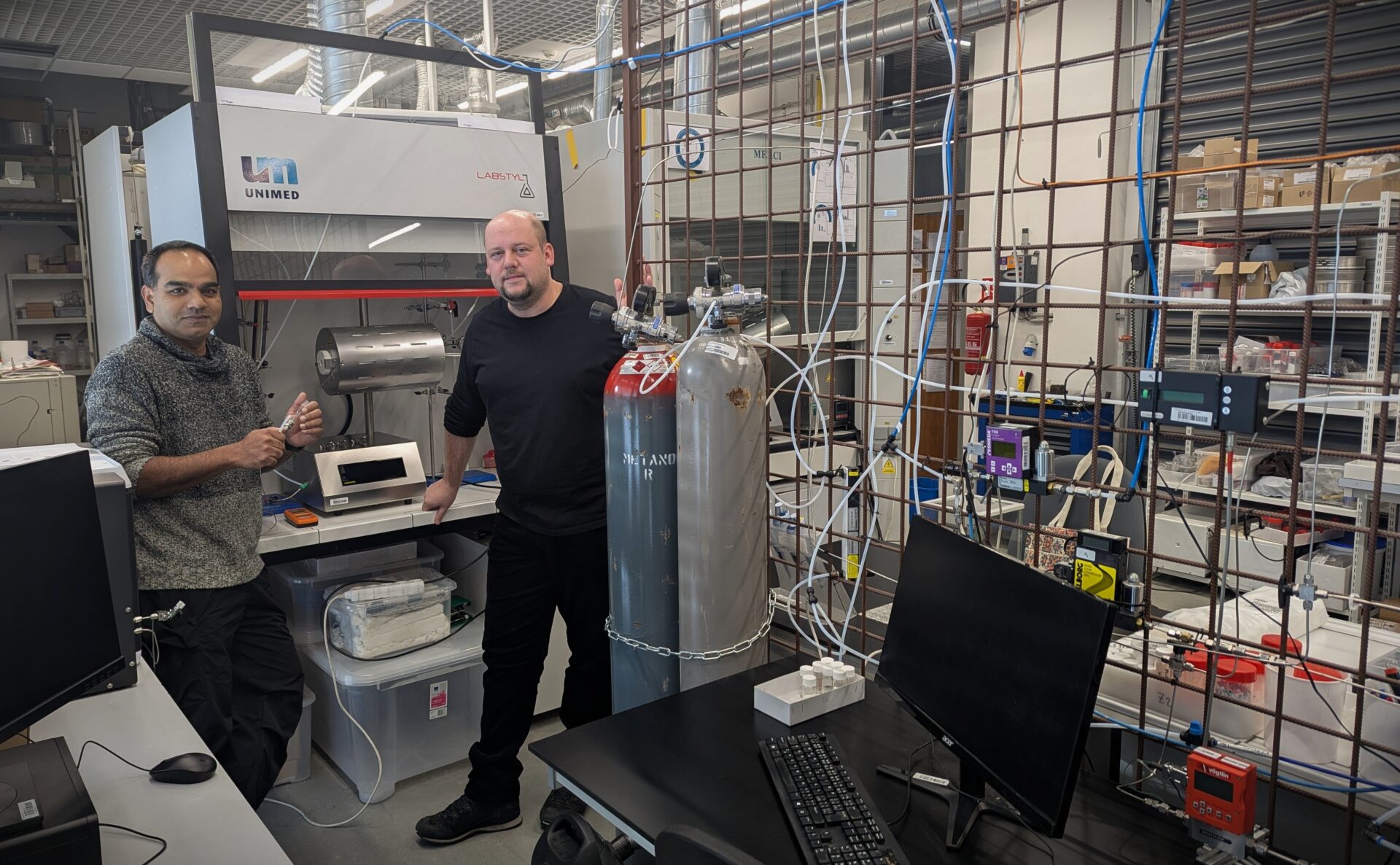
An international team working on the GeniusFuels project, which also involves experts from VSB – Technical University of Ostrava, is developing advanced methods for producing low-impact fuels from renewable energy and biomass waste. The project integrates several advanced technologies, including high-temperature water electrolysis, biomass gasification, and catalytic conversion, to generate “green” fuels such as methanol and dimethyl ether. These products offer viable, sustainable substitutes for maritime shipping and heavy road transport.
In the initial stage, researchers produce “green” hydrogen through water electrolysis, i.e., decomposing water using renewable energy. The process yields oxygen and steam as by-products, which are then utilised in biomass gasification to create a synthesis gas rich in hydrogen and carbon monoxide. This gas is then converted in a reactor into methanol and dimethyl ether, environmentally friendly fuel options suitable for maritime shipping and long-haul road transport.
A unique combination of multiple technologies
“What sets the project apart is the full integration of all steps, making use of the generated heat as well as every substance formed along the way. On top of that, the process yields biochar as a secondary product. This carbon-rich material created during gasification can be applied to soils, helping enhance their properties and improve water retention,” explained Pavel Lestinsky, the VSB-TUO lead researcher from the Institute of Environmental Technology (IET), part of the Centre for Energy and Environmental Technologies.
IET serves as the sole Czech partner in the consortium, which brings together academic and industrial institutions from Italy, Sweden, and France. The project is led by the University of Bologna in Italy.
The teams complement each other
Biomass gasification takes place in a patented reactor developed by the Italian company Iridenergy, designed to handle both loose and slurry biomass. The project will evaluate the SOEC electrolysis unit supplied by Italy’s Solydera in partnership with CNR (Consiglio Nazionale delle Ricerche). Specialists from Hulteberg in Sweden are responsible for purifying the synthesis gas and, together with their Italian partners, for developing robust catalysts. The concluding phase, the synthesis of sustainable fuels, is undertaken by researchers at CNRS (Centre National de la Recherche Scientifique) in Strasbourg. Close cooperation across all teams reflects the core idea of the CETP (Clean Energy Transition Partnership) initiative.
The Ostrava team will draw on their long-standing expertise in thermochemical processes, concentrating, for instance, on characterizing and analyzing waste biomass and the resulting biochar, as well as employing catalysts to break down tars and hydrocarbons. Their tasks also include removing acidic contaminants such as hydrogen chloride and hydrogen sulfide from the synthesis gas, and contributing to the calculation of material and energy balances for the applied processes.
The path to sustainable industrial solutions
“The GeniusFuels project illustrates how the hydrogen economy, the bioeconomy, and the circular economy can be genuinely interconnected, offering not only greater energy self-sufficiency and lower emissions but also new sustainable pathways for industry. This approach is crucial for the EU as a whole but also for the Moravian-Silesian Region, which is currently undergoing an energy transition tied to moving beyond coal,” Lestinsky added.
The project will run until November 2027. It is part of the CETP 2023 – Clean Energy Transition Partnership programme. Funding is provided by the European Commission, national agencies of individual countries, and industrial partners. For the Czech Republic, the project is funded by the Technology Agency of the Czech Republic (TACR) with EUR 132,624.
The project is co-financed with state support from the Technology Agency of the Czech Republic from the SIGMA programme within the ERA-NET Cofund/European Partnership (CET Call 2023 Partnership) call.
„This research was funded by CETPartnership, the Clean Energy Transition Partnership under the 2023 joint call for research proposals, co-funded by the European Commission (GA N°101069750) and with the funding organizations detailed on https://cetpartnership.eu/funding-agencies-and-call-modules.“
