
Cooperation among atoms is desirable. For example, for more efficient water electrolysis
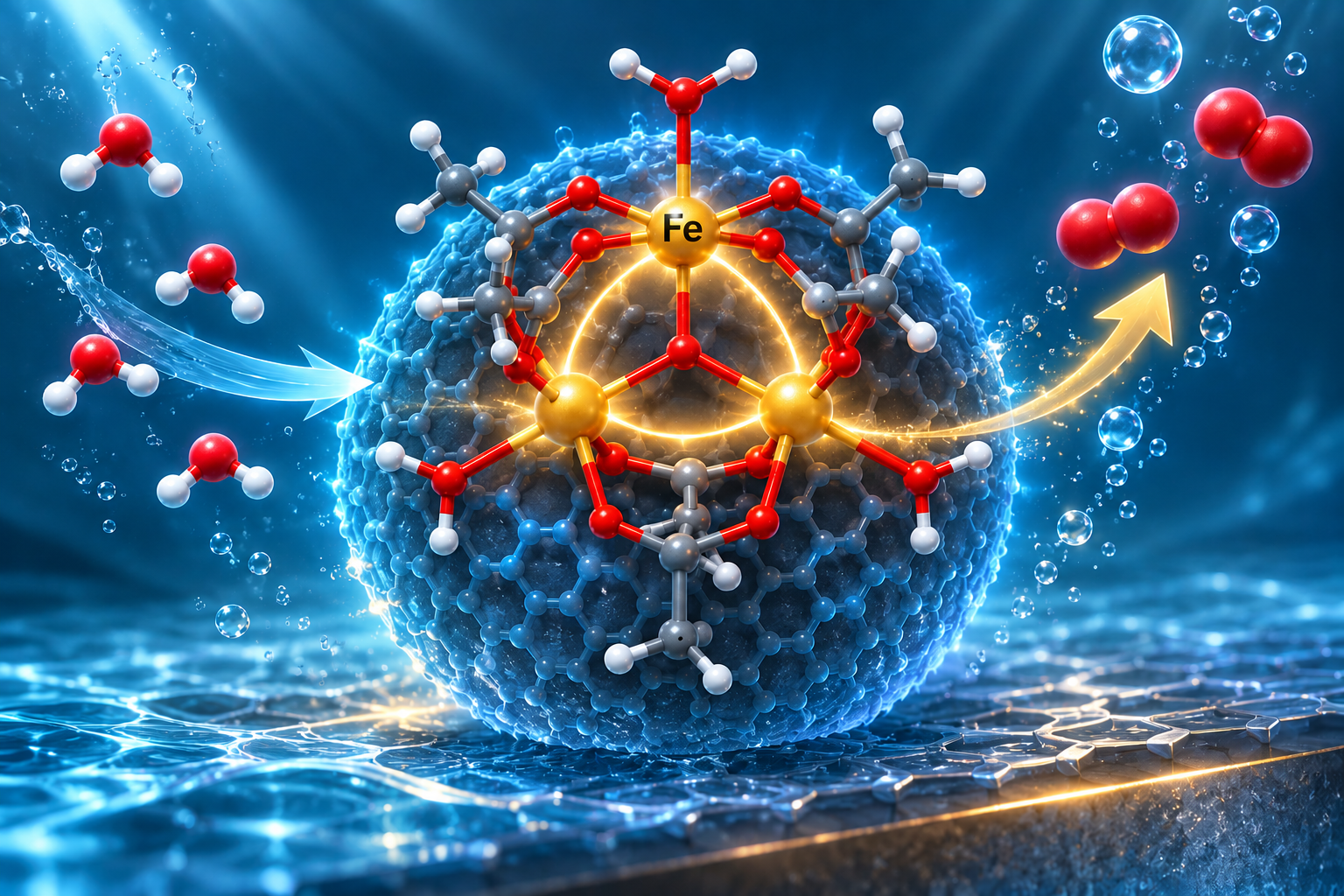
Scientists from the Materials-Envi Lab (MEL) at VŠB-TUO and CATRIN at Palacký University, together with colleagues from France and Italy, presented a new approach to increasing the efficiency of water electrolysis in the journal *Advanced Functional Materials*. This unique system utilizes three neighboring iron atoms that cooperate with carbon dots, forming a powerful “team” for the efficient electrochemical decomposition of water.
“We have developed a unique catalytic system in which three adjacent iron atoms form a cooperative center whose individual atoms, anchored on ultra-small carbon dots, communicate electronically with one another. The uniqueness of this system lies in the fact that the iron atoms do not act independently. They interact with one another, exchange electrical charge, and cooperate during the catalytic reaction, while the surrounding carbon nanostructure actively facilitates electron transfer,” said corresponding author and head of the MEL Center for Energy and Environmental Technologies, Radek Zbořil, who also works at CATRIN in Olomouc.
Water electrolysis is a key technology for energy conversion and sustainable chemical production. However, its efficiency is significantly limited by the slow oxygen evolution reaction (OER), which is one of the main obstacles to the electrolytic splitting of water.
“By linking clusters of iron atoms with an electronically optimized carbon structure, we achieved exceptional catalytic efficiency in the oxygen evolution reaction, which requires a potential difference of only 110 mV.” “Under our experimental conditions, the new catalyst even outperformed the reference catalyst based on ruthenium oxide (RuO₂). Importantly, instead of precious metals, we used iron—a metal that is abundantly available and inexpensive,” added Aris Bakandritsos, another corresponding author based at MEL and CATRIN.
The study also demonstrates the potential of combining nanotechnology and atomic engineering to address key challenges in the field of sustainable energy technologies. The presented solution demonstrates that the properties of catalysts can be specifically influenced not only by controlling individual atomic centers but also by designing the interactions between neighboring atoms and the nanostructure to which they are anchored. This approach may thus serve as inspiration for other catalytic reactions in the fields of sustainable chemistry and energy.